


End-of-day trading is exactly what it sounds like: a trading strategy that makes its decisions using the market's closing data rather than requiring you to watch the market throughout the trading day.
That sounds simple, but it makes a big difference in how a strategy is actually used. A strategy that depends on intraday price movements may require constant monitoring, quick decisions, and the ability to react while the market is moving. An end-of-day strategy can work very differently because the market closes, the day's data is available, and the strategy determines what should happen next.
That's the approach I prefer for systematic trading.
Why the Daily Close Can Be Enough
Not every trading strategy needs to know what happens every minute of the trading day. If the rules are designed around daily data, then the daily close may provide everything the strategy needs to make its decision.
This is particularly useful for mean-reversion strategies. A strategy may be looking for a significant decline that meets a specific set of conditions, but there's no requirement that I watch the market develop that condition minute by minute. I can use the completed daily data, calculate the levels required by the strategy, and prepare for the next trading decision.
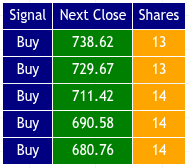
That changes the experience completely. Instead of asking what the market is doing right now, I can ask a much simpler and relaxed question: What does today's completed data tell me to do - for tomorrow?
End-of-Day Trading vs. Intraday Trading
Intraday trading and end-of-day trading aren't simply two versions of the same thing. They require different approaches to execution.
Intraday trading can require monitoring price movements as they happen and making decisions while the market is open, which can mean more screen time, more opportunities for signals to change, and more decisions that have to be made in real time. None of that is inherently wrong, but it adds complexity to the process.
With an end-of-day strategy, the decision can be based on completed daily data. I can calculate the required trading level after the day's information is available and prepare the order without having to monitor every movement leading up to the close.
For me, reducing the amount of real-time decision-making is important. A systematic strategy should make the decision easier, not create another reason to sit in front of a screen all day.
Why the Closing Price Matters
The closing price is more than just the last price printed on the screen. For a strategy built around daily data, it's the completed result of the trading day.
That makes it especially important when an indicator is calculated from daily prices because the final closing price determines the final value of the indicator for that day. If my trading rule depends on that value, I need to know what price would satisfy the rule.
This is where the idea behind my RSI PriceSolver™ System becomes useful. Instead of waiting until the final minutes to see whether RSI has reached a particular threshold, PriceSolver works backward from the RSI condition to calculate the closing price required to produce it.
I can therefore know the relevant price before the market closes rather than waiting until 3:59 and trying to make a decision under pressure.
Why I Use Limit-on-Close Orders
Knowing the required price is only part of the process. I also need a way to execute the trade that fits the strategy.
That's why I use limit-on-close, or LOC, orders for PriceSolver signals. An LOC order tells the broker that I want the trade executed at the market close, but only if the closing price meets my specified limit price. This fits the logic of PriceSolver very well. The calculation gives me the price required by the strategy, and the LOC order allows me to put that requirement into an actual order before the close.
Most importantly, I don't have to sit there at 3:59 waiting for the signal and then scramble to enter a trade. The calculation and the order can be prepared ahead of time, even the evening before, and if the market doesn't close at a price that satisfies the rule, the order doesn't execute.
Trading Without Watching the Market All Day
This is probably the biggest practical advantage of an end-of-day approach for me.
I don't need to know what the market is doing every minute. I need the completed daily data, the rules of the strategy, and the price required to execute those rules for tomorrow's close.
That creates a much simpler routine. After the market data is available, I calculate the levels, determine whether a trade is required, and prepare the appropriate order. Once that's done, there's nothing productive to gain from watching the market tick by tick.
This doesn't mean the strategy is passive or that nothing happens during the day. It means the strategy doesn't depend on me being present to make a series of decisions while the market is moving.
That distinction matters. The goal isn't to eliminate trading decisions. The goal is to make those decisions according to rules, at a time when there's enough information to make them calmly.
Can Systematic Trading Really Be Simple?
I think it can, but simple doesn't mean simplistic.
The strategy still has to have rules, those rules still have to be tested over a long history, and the risks still have to be understood. The execution also has to be precise.
What I want to eliminate is unnecessary complexity.
If a strategy can make its decision from the daily close, I don't need to watch the market all day. If I can calculate the required price before the close, I don't need to wait until 3:59 and make a rushed decision. If I can place an order that executes only when the required closing condition is met, I don't need to chase the market.
That's the idea behind my approach to end-of-day trading: know the rule, know the price, prepare the order, and let the market determine whether the conditions are met.
For me, that's what makes systematic trading practical. The objective isn't to make trading more complicated. It's to remove as much unnecessary decision-making as possible while still following a clearly defined process.
This content is for informational and educational purposes only. It is not financial advice or a recommendation to buy or sell any security. Trading involves risk, including possible loss of capital. Past performance is not indicative of future results.