


One of the problems I ran into when developing systematic mean-reversion strategies was the timing of an RSI signal.
If my rule says to buy when RSI reaches a certain level, the traditional approach is to wait for RSI to get there and then decide what to do. For an end-of-day strategy, that can leave me watching the market late in the day, waiting to see whether the signal appears.
I didn't like that at all.
Being forced to make a trading decision at 3:59, with the market about to close, is exactly the kind of situation I want a systematic strategy to eliminate. There is very little time to think, the price is moving, and a decision that should have been made calmly can suddenly become a rushed decision.
So I aspired to find something better, something I had never seen mentioned in any book I had ever read or any video I had ever watched. It was a complete revelation to me. I asked a simple question:
How can I know the executable price before the close?
And the answer to that question became the idea behind the RSI PriceSolver™ System.
The Problem With Waiting for RSI
RSI is calculated from price, so its value changes as the price changes. If I am waiting for RSI to reach a particular threshold, I am essentially waiting for the market to move far enough for the indicator to give me the signal.
But I do not actually need to wait for the RSI value itself.
If I know the RSI threshold I want to reach, and I know the previous price and RSI information, I can work backward through the RSI calculation to determine the closing price that would produce that threshold.
That changes the question from:
"Has RSI reached my target?"
to:
"What price would make RSI reach my target?"
And this is the basic idea behind PriceSolver.
How PriceSolver Works
The calculation starts with the way RSI itself is calculated.
RSI uses the relationship between average gains and average losses. Wilder's formula converts that relationship into an RSI value. If I start with a desired RSI value instead, I can reverse the formula to determine the relationship between gains and losses that would be required.
From there, I can work backward through the calculation and solve for the price change required to produce that RSI value.
In practical terms, I start with the market's existing data and my predefined RSI threshold. PriceSolver calculates the closing price that would cause RSI to reach that threshold. I then verify the result by putting that price back through the RSI calculation.
So PriceSolver is not estimating a price from a chart; it is solving the RSI calculation in reverse.
I start with the RSI target and solve for the price.
Why Knowing the Price Before the Close Matters
This is where PriceSolver becomes useful in actual trading. An RSI reading is information. It tells me whether the indicator has reached a condition I have defined. But if I have to wait until RSI actually reaches that level, I may not know whether I have a trade until the very end of the trading day.
That can create exactly the kind of situation I want to avoid. I could be watching the market at 3:59, waiting to see whether RSI finally reaches my threshold, while the price is still moving and the market is about to close. If the condition appears, I then have to make a quick decision and get the order entered before the close.
There is very little time to think, and the pressure of those final minutes can turn a completely mechanical strategy into a rushed decision.
PriceSolver changes that process. Instead of waiting for the RSI condition to appear, I calculate the price that would produce that RSI condition before the close. I know the price I am looking for ahead of time, so I can prepare my Limit-on-Close order calmly any time of day or night rather than trying to react at 3:59pm.
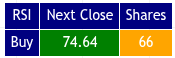
That means I can be at the beach or visiting with friends or spending time with my loved ones.
The process becomes simple: define the RSI condition, calculate the required price, prepare the order, and let the market determine whether that price is reached.
I am not predicting where the market will close. I am not deciding whether an RSI reading is "close enough." I am simply calculating the price that satisfies a rule I have already defined. If the closing price does not satisfy that condition, the order does not execute.
That is the practical difference between an indicator and a PriceSolver level. The indicator tells me what is happening. PriceSolver tells me the price I need to act on.
PriceSolver Does Not Predict What Happens Next
The calculation tells me what price would produce the RSI condition. It does not tell me what the market will do afterward. It is not predicting anything.
The market may reach the calculated price and continue falling. It may never reach the price at all. A mean-reversion signal can also occur during a much larger decline, even a bear market.
That is why PriceSolver is an execution tool, not a prediction tool; it's not a black box.
The underlying trading strategy still has to be tested over a long history and evaluated by looking at the complete results, including return and drawdown. A more precise entry price does not make a trading strategy automatically profitable. It simply makes the rules more precise and the execution process more systematic.
Reverse Calculation Is a Bigger Idea
RSI is where I applied this concept, but the idea does not necessarily stop with RSI.
Most indicators work in one direction. Price goes into the calculation, and the indicator comes out. Reverse calculation asks whether we can start with the desired indicator value and work backward to find the price that produces it. Moving averages, Bollinger bands, MACD, etc., are all valid candidates for PriceSolvers. You can try it for yourself!
Of course, not every indicator can be solved this way, and some may require much more complicated mathematics. But whenever an indicator has a clear mathematical relationship with price, it is worth asking whether that relationship can be reversed.
That is what makes PriceSolver interesting to me beyond RSI itself.
Why I Built PriceSolver
I built PriceSolver because I wanted a better way to handle a simple problem.
I did not want to wait until the end of the day to find out whether my RSI condition had occurred and then make a rushed decision with the market about to close. I wanted to know the relevant price ahead of time.
PriceSolver does that by working backward from the RSI threshold to the closing price required to reach it. The indicator provides the condition, and the reverse calculation provides the price. The trading rules determine what I do with that price.
For me, that is the real value of PriceSolver. It takes something I would normally have to nervously watch for and turns it into something I can calculate in advance, even the day before.
This content is for informational and educational purposes only. It is not financial advice or a recommendation to buy or sell any security. Trading involves risk, including possible loss of capital. Past performance is not indicative of future results.